The Matterhorn
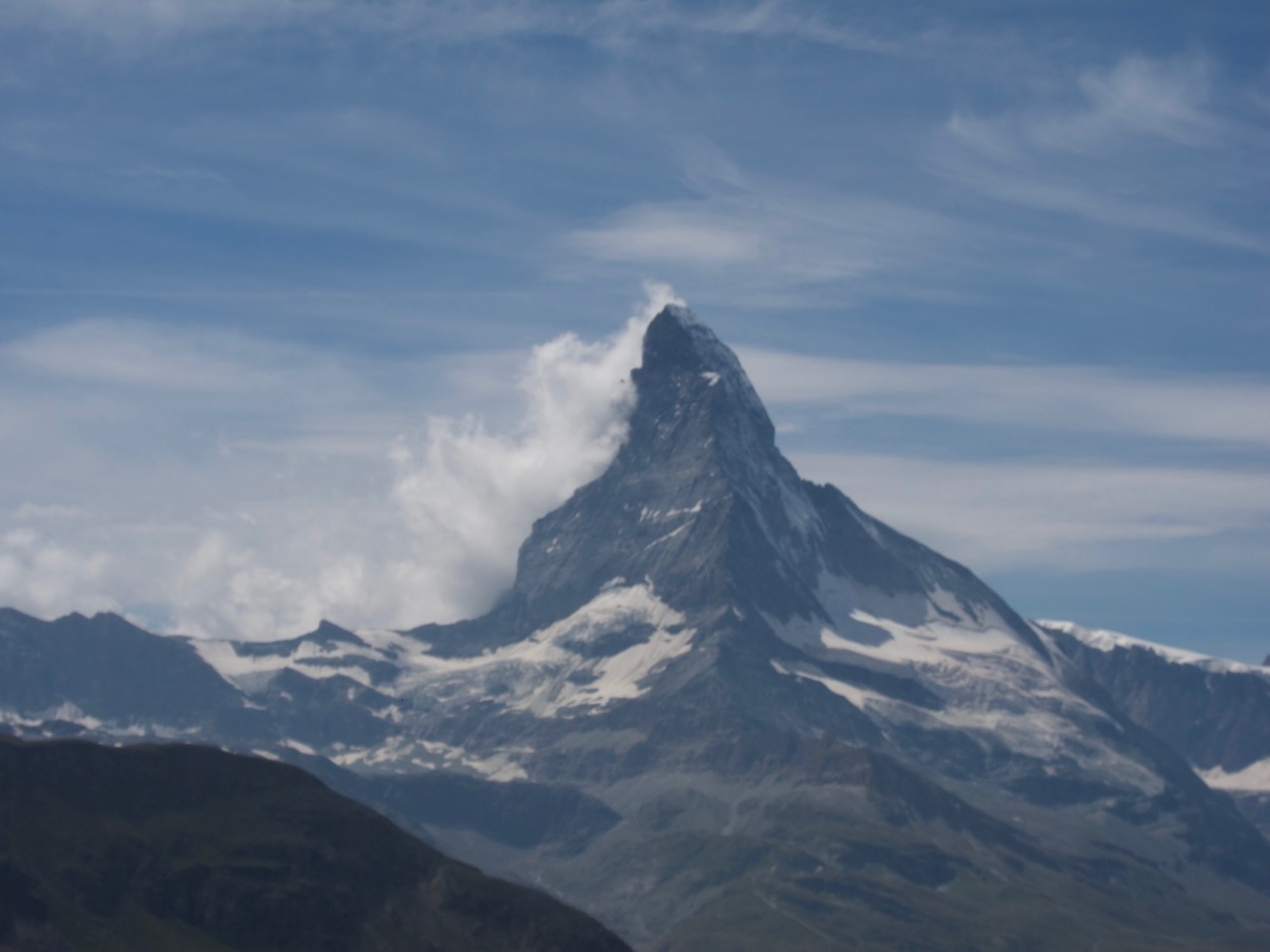

I climbed the Matterhorn!
Let me start from the beginning of my trip. It was an inauspicious start. I visited 6 airports on my way to Zurich. My original flight was from National Airport ~ 4pm. I checked in online in the morning, only to find that my flight to Newark was canceled and I had be rebooked on a flight the next day. I did not consider this acceptable, as I was meeting Walter in Newark and flying to Zurich. As an aside, this was not the best awareness on my part, oh well. Anyway, I had my mom drop me off at National, and I was on the phone with United while being dropped off. I thought about trying to get a train to Newark, but did not have enough time. I did get booked on a flight that would get me to Zurich about the same time, but it started from Dulles. I jumped in a cab to Dulles. I lost my upgrade to business class, but after a number of phone calls, I got upgraded back to business class. I would be very happy to fly business class regularly. I then spent the next 2 hours sitting in a plane on the tarmac, weather delay. The flight to Frankfort was great, but I did not make connecting flight to Zurich. When I got off the plane, I was handed a boarding pass for a flight to Dusseldorf. I had plenty of time, but screwed up by not checking in way ahead of time. So, when it was time to get on the flight, I was behind a family that had all kinds of problems. There was some communication issues in Frankfort with the gate agent. In addition, because of my switch to originating from Dulles and self checkin, I did not have a baggage ticket. I am not sure if I screwed up or airline people. Anyway, I got on flight to Dusseldorf. My connection to Zurich was on a Swissair flight. I spent many hours in Dusseldorf airport, very tired, and when I tried to board Swissair flight was told that I was not listed on flight. There was no one for me to talk to. My only option was to leave the secure area and go to the Lufthansa counter and try to get this problem solved. I was a bit uneasy at this prospect, but had no choice. The Lufthansa help desk agent was helpful though. She got me on a flight to Zurich, but I had to go to Copenhagen first. Finally, Zurich bound. I think I arrived in Zurich about the same time as I would have if I had taken the original rebooked flight on Saturday morning from DC. We did have to gather my baggage the next morning, which happily made it Zurich, a bit after I did, but it did make it.
As an aside, when I flew out of Amsterdam to come home, the security person takes your passport and scans it and sees where you have been. My 6 airport day caused a bit of a stir. When she came back to me and asked “Do you fly a lot?”, I said, no, but are you looking at my 6 airpot day, and then I described the agony. All was fine, and even a bit humorous. European airports are much less stick up the ass uptight in my somewhat limited experience.
After finally making to Zurich, and meeting up with Walter, we proceeded to Zermatt by train on Sunday morning. I am not going to detail a lot of Zermatt, but it is a place I would visit again. We arrived on a day of festival. The town square had picnic tables set up, and food and drink were available, and folk music was being played on a stage. The huge cowbells stand out, not very musical, but a bunch of people in traditional dress ringing huge cowbells. Walter and I got raclette – which is a bit of melted cheese (raclette), two small pickles, two small potatoes, and 2 pearl onions on a plate. It was good. The whole thing felt so very European.

After a couple of days in Zermatt, we had a training climb up Pollux. The Zermatt guide service requires that people who want to climb the Matterhorn first complete a training climb so a guide can assess whether you are capable. Climbing Pollux involved a ~3 mile hike across a glacier, about 600 feet of climbing (class 4 mainly, with maybe a little class 5, and a couple of fixed ropes/chains), and then a hike up the snow arrete. It was a fun, and I had no problems, except that I have not walked on a glacier before. We were roped to our guide Tomas. Tomas, me, Walter. I followed and stepped where Tomas stepped, but twice I stepped wrong and did not see small crevasses and fell down in the glacier up to my hip. Not a big deal, except Tomas yelled at me to “open my eyes,” after the second time. My response was that I have never walked on a glacier and I did not know what I was not seeing. I was a bit annoyed, Walter told me that if he had been second instead of me, he probably would have done same thing. Tomas did not provide a lot of direction. Other than that, the day was fine. The climbing and getting to the summit was not so hard. Tomas and I did not become great friends, but it was fine.
After this climb/hike we took the tram/gondola back down to Zermatt. During this trip, Walter and I had a fantastic view of the Matterhorn. It was just the two of us in the gondola, quiet. We had a great view of the Hornli route, and it scared the crap out of me. It looked really steep, and long and exposed. I realized that I was looking at 4000 feet of up, but my brain could not break it down into reasonable climbing bits. I was having significant doubts about climbing the Matterhorn.
We had a few days before we had to commit, and we did not do a whole lot of physical activity, and it was probably a good idea for me to rest a bit. The mountain was not particularly visible during these days. It was partially covered in clouds and the weather did not seem great. The forecast for Saturday was for 10 inches of snow to fall at the very top of the mountain. It seemed that maybe I would not have a chance to climb the mountain, and taking the decision out of my hands seemed almost to be a good thing. I was still having a hard time wrapping my brain around what I was seeing. The weather cleared on Sunday, and while snow had fallen on the mountain, it did not seem too be too much, but I don’t have experience to really assess.
Sunday was the day to stop in the guiding office and pay my money to climb. Walter and I had a long discussion about, he decided he wasn’t fit enough to make the climb. I decided that because the weather was great, I did my training, and was fit, and I admitted to myself that if I did not do it, that I would most likely not be back next year. I wanted to try. It would not have been acceptable to not try. As it turns out, as soon as I paid, the stress and tension I had been feeling the past few days went away. I had been nervous about making the decision more than the climbing. I felt pretty calm about it, focused, not talkative, but calm.
I had to get to the Hörnli Hut the next day. I could have hiked all the way up to the hut, but that would probably be a 6 or so hour hike. Instead, the normal way is to take a tram ride to the Schwarzee station and hike the last ~2000 ft and maybe 5 miles. It took 2 or so hours for this hike. The sun was out and it was a nice hike, if a bit warm. The views of the Matterhorn were exceptional and were right up the Hörnli ridge that I was going to climb.
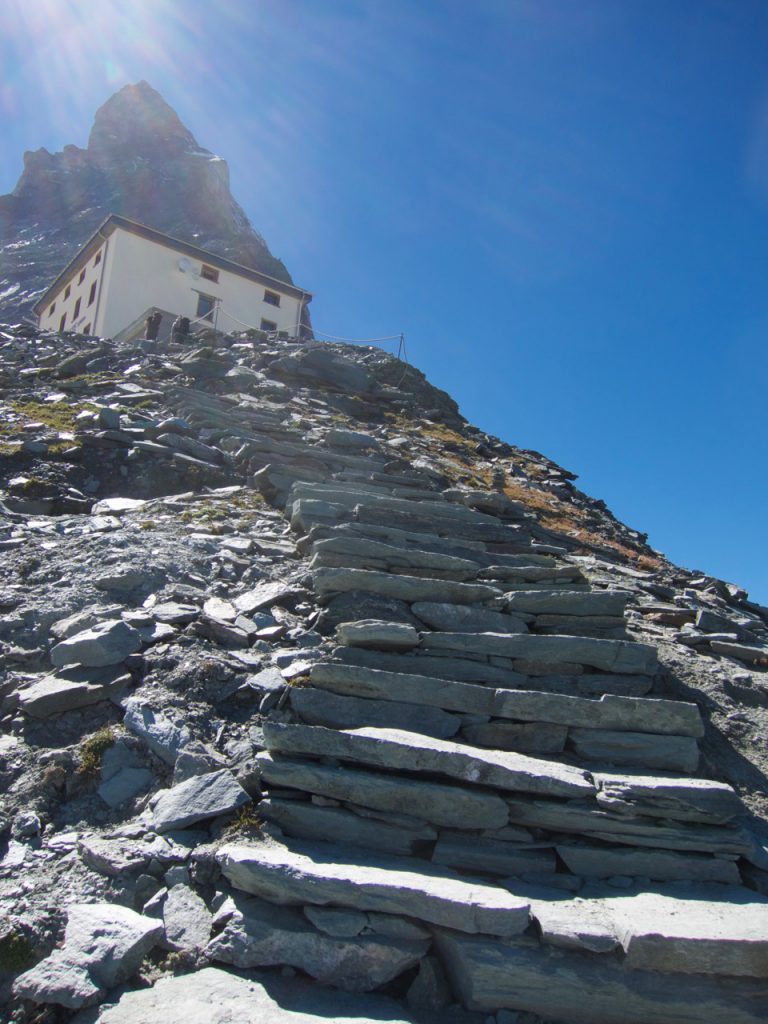

Once I reached the Hörnli hut, I checked in and got a room. But I must first describe what a “room” is. A lot of people climb the Matterhorn each day when the weather is good. And I had about as ideal weather conditions that you can hope for. It was warm, sunny, and very little wind, so no chance of storms developing and no wind to make the exposure a bit more exposed. I digress though, the Hörnli hut is meant to be a place where a 100 or so people can stay overnight and climb the mountain. I was in a room with 5 others, three sets of bunk beds, the beds themselves were skinnier than a normal twin bed. The room is small, maybe 7 x12 feet. There was a window, but no AC, which seems reasonable at 10k feet, but 6 people in a small room generates heat, and I could not open the window, or I don’t think I could, and I did not want to cause problems. The hut also wants you to use these stupid sheet sleeping bags, such a european thing. There was no way I was going to wrap my legs in a confining bag so they were even more warm. So, I ended up laying on top of my sheet, in the warm room, from 9pm to 4am. I got maybe 2 hours of sleep. I also had the one bed where if I moved the pillow too far it would fall to the floor, as I had no headboard. This was not a first come first served situation, I was assigned this bunk. I did not hit the lottery here, but no one does, so it is what it is. Oh, and it is $200 a night, plus you pay for you guides night at the hut.
Around 6:30 the night before, the Zermatt guides gather at a separate table and meet the people they were going to take up the mountain the next morning. Dinner was served, which I of course could not eat. It has been pointed out to me numerous times that this is a choice, and while technically true, saying so does not quite describe my allergy situation properly. A soup, maybe butternut squash, followed by a pork chop with a sauce, au gratin type potatoes and some vegetables and pudding for dessert. Pretty nice considering that I think all the food and supplies are carried up by helicopter. I ate a sandwich I made down in Zermatt and drank some wine.
The Zermatt guides are viewed with I think a great deal of reverence in Zermatt. The history of Zermatt and the guides are inextricably linked. There is a special part of the cemetery at the local church with graves of mountain guides and people who died climbing the mountain, back to 1865, when the first successful ascent happened. The descent was not successful.
The Zermatt guides get special treatment at the Hörnli hut. My guide was Martin, from Austria. He guides people like me up the Matterhorn during the summer and then goes back home to Austria in the winter and does ski guiding. He has been up the Matterhorn 104 times and was going up 5 times the week I went. I would guess he is at 107 times up now, or maybe more. I climbed on Tuesday August 23, and he was booked the rest of the week. I did not ask specifically, but I got the impression that he goes up 5 days in a row, but the guides get to decide whether they are ready to go, which makes sense because they need to be sharp each time they go up the mountain. He spoke english well, but with an accent, and I had a bit of a hard time communicating with him. I was also a bit stressed, and I tend not to be overly talkative when feeling that way. I also got the feeling that Martin did not have a lot of confidence in my ability to reach the summit.
After dinner, Martin wanted to see my pack and gear. He told me that we would not be using the ice axe ;( and that I should just leave it where it was, which is in a rack, as ice axes are not to be taken to the rooms. Oddly, they don’t want people carrying around ice axes in the hut. 😉 Martin looked thru my gear. He got rid of a couple of things, approved of my jackets, nixed my gopro, I think mainly because I had an old helmet that is relatively heavy. He was very concerned about weight, which I fully understand. He told me specifically what to wear in the morning, which was my base layer shirt, nothing for head warmth, and no gloves. I was a bit dubious, and disappointed about camera, but did not argue and it turned out he was correct about what I should wear. Although I think the gopro would have been ok.
After the gear check, I went to bed, it was before 9pm. Everyone woke up a 4am. This is to get yourself ready to leave at about 4:45am. Breakfast was served at 4:30 and was hot tea, yogurt and some cheese and meat, and of course bread. You had about 10 minutes to eat. I ate two yogurts, and piece of cheese, and had some tea. I walked outside and was surprised at how warm it was.

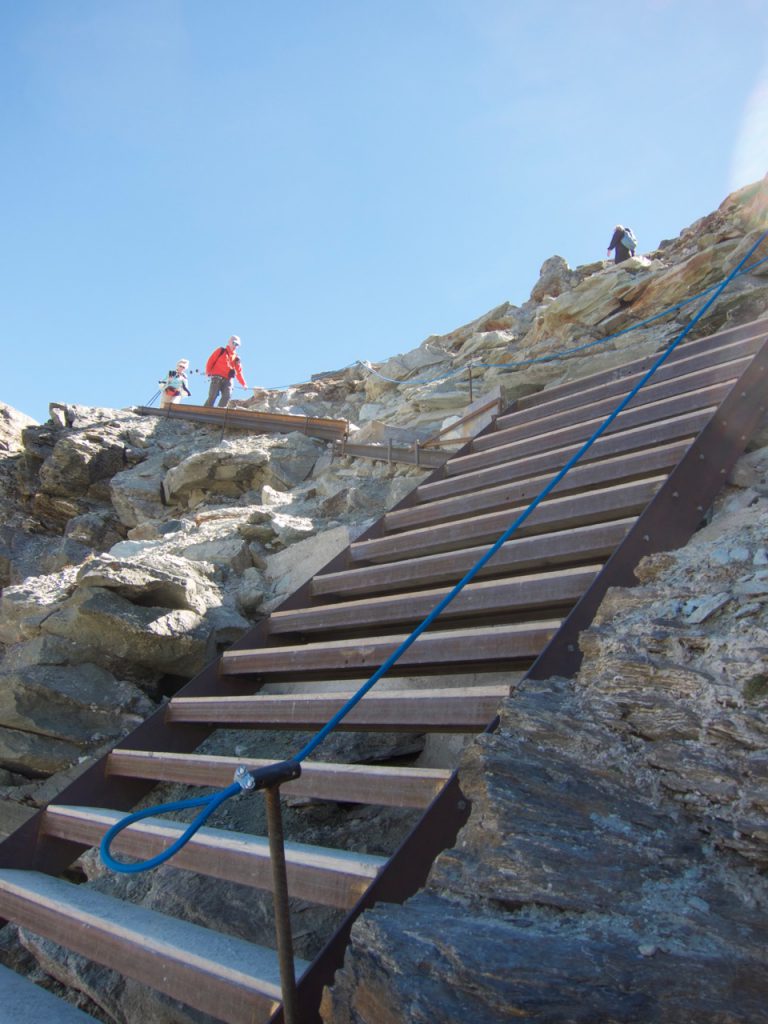
At about 4:40 I found Martin by the door where he said he would be. This is another instance I think, where Zermatt guides get preferential treatment. I think the guides get their position at the front door according to various rules known only to them, and being a Zermatt guide gets you right by the door. But to call this a system is a rather tenuous definition of the word. I found Martin and he tied me to him with the climbing rope. The other guides all did the same thing with their clients. This meeting area was small, and very crowded, with some pushing and shoving while people tried to move around. A guide, I think, made a comment about someone not knowing the system, and I got a rather unappreciative look by chiming in with “This is a system?” At about 4:45 the door was opened, (it opened in, which caused problems at you might guess), and guides and clients poured out the door. Happily, it was not a running to the wall chaotic scene, it seems that the order the guides got out the front door is the order they stay in. This is nice, as there is a short walk around the building and up some stairs and over a little hill and down across a snowfield to get to the wall. But there is no hesitation allowed. Once we reached the base of the mountain we had a short wait and Martin and I were about 5th in line. I could see lights from climbers who started much earlier, but they did not stay in Hörnli hut. The first part of the climb is a fixed rope up about 20 feet or so. A fixed rope is about a 1 1/2 inch diameter braided rope affixed to the rock in convenient places. It has some slack and you simply grab the rope and climb up the wall. It is generally easy and the purpose is to make climbing those sections faster so you don’t get big traffic jams.
Once I was up that first fixed rope, we just started moving up the slope. This was 4th class climbing mixed with some steep uphill hiking, in the dark. There was no time to enjoy the scenery, just go. I found myself breathing very hard just a few minutes into the climb. This was far from ideal, and I was thinking that at the time. I did not expect to be breathing this hard this soon. I think it was a combination of the elevation, the lack of sleep, and the lack of a warm up, but there was nothing I could do. Asking to stop a rest of minute is not allowed, or more specifically doing so may compromise your chances of reaching the summit. The guide considers it important to maintain position in the queu. We passed a couple of people and were passed by a couple of people during the first hour I would estimate. I was completely focused on moving forward and up. Hands and feet placed properly and taking 2-3 seconds rest whenever an opportunity presented itself. We passed a woman I had dinner with the night before about 20 minutes in, and I am pretty sure she was not able to complete the climb. I talked to another person I met after and he said that she was told that she had to speed up or she wasn’t going to be able to complete the climb. I don’t know the end result, but I don’t think she made it. The man I met after was successful and we finished about same time, but he started slow early and was told that if he did not speed it up he wasn’t going to summit.
We did not stop until we reached just past the Solvay hut about 2500 feet up the mountain. The Solvay hut is a small emergency hut perched on the side of the mountain. It is about 10ft x 10ft. A short distance past the hut we took about a 5 minute break for a drink of water and to put on some additional clothing. I don’t have any pictures from here, I took some on the way down, but my camera was set to movie and nothing turned out.
The sun rose I think about 1/2 to the Solvay hut, so it was light at this point. There was significant exposure in places while climbing to the Solvay hut, but I was so focused on what I was doing that I had absolutely no trepidation from the exposure. And by exposure I mean that falling from a spot means that you die. I was tied to the guide, and in places where there was significant exposure he would secure us in some fashion in case I did something stupid or slipped, but that did not happen, I was sure footed and climbed well enough. There were places where I was on a very steep slope, and also places where we were directly on the ridge, on rock that was say 24 in wide and steep long falls on both sides. These situations did not bother me. I was focused on where I was putting feet and hands, and for the most part did not see the exposure. This is actually a bit disappointing because I missed out on enjoying the views.
By the time we reached the Solvay hut, the temperature had dropped signficantly, my fingers were completely numb and swollen and while my core was chilly, I was fine, I debated putting a jacket on, and decided to do so, and that was correct decision. My numb hands made it difficult to place my hands and get a good grip during the last 1/2 hour or so up to the Solvay hut. I spent a good part of the rest break trying to get my gloves on. I could not jam my fingers into the finger holes very well, but eventually got it mostly worked out. We started up again shortly thereafter.
After the short break at the Solvay hut, we climbed for about another 40 minutes, and at that point reached the first snowfield. This was at the shoulder of the mountain, which is a clearly identifiable location on the mountain. I got another break here. A chance to get a drink and put my crampons on. From this point, my crampons were on until I got back to this point. After walking up the snowfield, which was not so difficult because steps were worn into the snow from people going up and down, which is why the ice axe was not needed.
Once past that first snowfield, we were back on bare rock, and right on the ridge separating the two faces. There was definitely exposure here, and it was a bit more challenging because of having crampons on. They are great on snow, and work fine on the rock, but it is a different feel, and a bit awkward. But again, I was so focused on just moving forward that feeling the exposure was not a problem for me. This section of dry rock turned into a section of steep rock with snow. Some of the climb was straight up and most of it was on the ridge. This was probably the hardest part of the climb. Also here were a bunch of fixed rope sections. Up to this point a fixed rope would cover a short section of rock, maybe 20 or 30 feet up, but in this section there was a bunch of ropes in a row or with small breaks in between. After about 2 1/2 hours of climbing, I reached these fixed ropes and I was tired. I took every chance I could to rest for 3-5 seconds, and I did not rest long because the guide would start pulling me along, that is not fun, and too much of that and the guide likely starts complaining to you about your speed. While climbing these ropes my triceps in both arms started cramping in waves, I guess I am lucky that it was not a complete muscle seizure, but waves of cramps in both arms. As as lifelong swimmer, having your triceps cramp is quite unexpected and downright weird. This was the only time during the climb that I told Martin I needed a second. I stopped for 20 secs or so, and 1 or 2 groups passed by, but after that I was mostly ok. I think this happened after the last fixed rope, or maybe just one or two left. Once we reached the end of the fixed ropes, the mountain is simply a very steep snow covered slope. I am not good at estimating the steepness, but it is very steep. The snow again had steps stomped into it from the many feet before me. I was struggling, but very close to the top, I went up this section essentially on all fours, not because of steepness, or fear of the exposure, but simply because standing was hard, I needed all four limbs to keep up. It was not elegant at all, but I did not then and don’t care now, I made it up.

Again, I can’t estimate the steepness of this top section, I am sure I can look it up, but if you fall here, your guide has very little chance of saving either you or himself. After 20 minutes or so of this top slope, we reached the top ridge. I instantly recognized it from the videos I had watched and I can’t express how I felt. Once you reach the top ridge, you tromp carefully across this snow covered top, to your right is the steep snow slow you just came up, and to the left is a sheer drop. There is no buffer, the top where you can comfortably stand on a flat surface is no more than 2 feet wide and really much less wide, the trail you walk on is maybe 10 inches wide. You tromp maybe 40 yards or so to the highest point and stop for a minute, get a few pictures, and say and get congratulations from others who are up there.

I worked so hard to get up there that I admit I was feeling choked up and very emotional. I was also wheezing a bit from the non stop movement and breathing. I expected this climb to be hard physically, but I did not expect what the relentless pace would do to me. It was not a fast pace, but the guides allow for little to no rest. From not being able to sleep, to not being able to let my muscles get warmed up properly, to the knowledge that asking for a break was the same thing as asking to go back, all led to me being in an emotional state that is hard to describe. I was certainly exhilarated, and not sure what else, but the sense of accomplishment was and is deep and abiding. I can imagine that if you were to climb this mountain, but be able to take all day, say 12 hours, instead of just 7 1/2 hours, it might be a completely different experience. Not sure how you could go about making that happen, but it might be worth it to try.


The view from the top of the mountain was fantastic, it is such an exposed spot that you can see a long way in every direction, breathtaking at the least. Plus being in a spot where just about every direction is perilously steep is very interesting.
Getting to the top of the Matterhorn is a fantastic accomplishment, but it is only 1/2 way, and going down, from what I gather and what makes sense, is way more dangerous. You are tired, and down climbing is more difficult than up climbing and you get much more opportunity to see the exposure. After we left the summit, we stopped at the edge of the summit right where we got to the top, there is a little ledge area that has room for a few people to sit down and relax and enjoy the view. It is also out of the wind, which was nice at the top of the mountain. I sat down and drank some water, I tried to eat a Kind bar, but I took one bite and found I was too tired maybe, or something, but the idea of eating was not pleasant. I did manage to down some shot blocks.
After about 10 min or so of resting, we got up to head back down. You can’t stay in that spot for too long, as other climbers are getting to the top and also want to sit down and rest for a bit. The first part of going down is walking with crampons down the steep snowy slope. This descend, in my mind is the most dangerous part of the whole climb. There were steps, making it a bit easier, I think. The guide makes the rope between you and him very tight, and I tested this by slightly stumbling on one of my very first descend steps. Not a big stumble, but it doesn’t take much. Anyway, that is when I discovered the tight rope. My thought is that if I fell, the tight rope makes it so I don’t start sliding down the slope and gain inertia (do I gain inertia?) and momentum. Because once you have momentum, there is very little chance the guide can stop your fall and he will follow you shortly thereafter. So the guides goal is to keep you upright or at the very least not sliding.

In any event, aside from that small stumble, I was fine going down this steep slope. In a bunch of places on the route, there are large rebar like steel rods, some with loops of various kinds. At these spots, the guide will lower you on the rope. I did not mind this at all. The lowering occurred in places where down climbing was the hardest, and also since there is only one route, there are people coming up as we are going down. So the lowering allowed us to somewhat bypass these logjams and continue on our way. Martin had to down climb each of these spots, but obviously he is used to doing this and knows how to work around people efficiently. There were numerous spots where I did grab a hold of the fixed rope and down climb myself, and based upon spacing, I think got pretty lucky in avoiding logjams. I had no problem with this down climbing. Finally getting a significant rest at the top allowed me to gain my equilibrium and also going down does not stress the cardio quite as much, duh. There was one spot where a group was coming up the rope and my guide told me to down climb. I think it worked out that the other guide had just reached the top of this rope, but his two climbers had not started up yet. As I got down to them, they started cursing me a bit, in Italian, I think. I looked at them and said, “I am doing what my guide tells me to” and left it at that. A bit further down while I still had my crampons on we reached a point of dry rock on the exposed, skinny ridge. I was of course still quite focused, but placing your feet with crampons at this exposed spot was a bit of a challenge, but at this point I was starting to enjoy the whole thing a bit more.

There is not a whole lot more to add, coming down was just an exercise in being careful. We did take a nice long break of 15 min or so, as Martin had received a phone call earlier and wanted to call that person back. So rush rush rush, unless your guide wants a break. :). Towards the end I started to feel more tired and had to make sure I did not stumble too much. At one point Martin told me that I was doing everything just right on the way down, meaning that my down climbing technique was right on. Earlier, at the top I think. He told me that he was really impressed with my fortitude. That is not the exact word he used, but I think the essence of what he said is that he did not think I was going to make it up the mountain. I think my loud out of breath breathing and wheezing, and cursing towards the end made him think I was gonna crap out, and I can’t really blame him for thinking that. I did not think that at any time, but I was taken aback at how I was struggling from basically the first step. I know I was in good shape, and I know that 14k feet is not unreasonable for me, so it really surprised me that I could not catch my breath, or when I did get a bit of easy movement and did catch my breath on the way up, I went right back to hard breathing as soon as the climbing difficulty increased. My theory is that this was climbing and not hiking, and that I am used to interval training with small breaks to let the lactic acid in my muscles reduce, and finally, I am getting old and require a good bit of warm up time and I got zero warm up for this activity.
I am writing this for my own benefit as much as anyone else’s, but am happy to share it with friends and family and maybe you will find it interesting. While this was not a life changing experience, it was a significant accomplishment that I will carry forward and think about. I have had my share of failures over the years, some physical and some in other areas of life. I went into this climb with a real lack of knowledge about what I was specifically getting into. A view of the mountain I had a few days before my climb scared the crap out of me, and when Walter decided that he was not going to attempt the climb because he wasn’t fit enough, I could have easily decided to pass also. I did not because I wanted to do this, and I felt that I would not be able to say I was coming back next year to try. I prepared as I expected to, the weather was great, you don’t climb with someone other than your guide, so Walter not climbing did not change anything for me. So I felt I had to go. It was a good choice. But this was hard.
On the way down, I finished my water with about 45 minutes of climbing left, I was quite dehydrated and had been thinking about having a cold beverage once I got off the mountain. So, after I got down, I bought a .5L coke and a .5L powerade. That was about $14. This is Switzerland, which is expensive, but in this case you are a totally captive audience, not sure what price could have made me not buy these drinks, but it would have needed to be significantly higher. I had intended on buying some wine and sitting on the beautiful porch at a picnic table and enjoying a view of the mountain and my accomplishment, but I realized that I was woefully dehydrated, and had eaten very little all day, and the previous night. Drinking wine might make getting back down to Zermatt, which included about a 5 mile downhill hike rather difficult. So, I passed on the wine an headed down. The hike down was fine, I put on my more comfy hiking shoes, and while it was hot it was fine. I got to the tram and got into a gondola and realized that I was missing a boot. I had tied them to my pack to head down and one of my $300 mountaineering boots was on the trail, somewhere. I got off the tram at the next station and went back up, thinking my boot might be right there at station but it was not. I saw four guys with helmets on their packs, so I asked them if they were going to the hornli hut, and they were, so I asked them to look for a boot. They said they would and that they would bring it back to Schwarzee station if they found it. I was way too tired to attempt to hike back up that trail. I just could not do it. Happily, the next day, I went to the Zermatt tram station and my boot was there. Someone took it to the Schwarzee station and it was sent down to Zermatt! I was so very happy to have 2 boots again.
As for Zermatt guides, I am not sure I would recommend them. They are obviously experienced, the two I met had each climbed the mountain over 100 times. They know what they are doing, and that is obviously invaluable. But they are completely uncompromising, which is not necessarily bad, but they want to to complete the climb in under 8 hours. By doing this they get to rest for the afternoon because they are likely going back up the next day. For them this is a business and how they make a living. Getting to the summit is incredible and beautiful and wonderful, but enjoying the climb up and down is also something that I would like to have experienced a bit more, but I say this as a mountaineer of now 1 mountain, so maybe that is not a reasonable request. I don’t know if other guides are more flexible or not, but it is worth exploring. I did see the night before I climbed numerous people getting off the mountain just before sunset. I have no idea what their experience was like, but they just might have enjoyed it more rather than it being simply an accomplishment. On the other hand, the same evening I saw people just getting to where you removed your crampons as the sun went down. Not sure I want to be on the mountain coming down as it gets dark.
As I get a little further from the climb, I am thinking about it more as an accomplishment. I think the intersection/conflict of climbing for the experience and the business of the guide making a living is a real issue, I am a bit less concerned. Getting to the top has its benefits.
Finally, the climbing was not hard in and of itself, but together with the distance traveled and pace and the exposure, it was incredibly hard. I did not feel unsafe or bothered by the exposure, but I think that to a certain extent is me and I don’t want to understate the exposure. I find it exhilarating more than scary.
It is worth noting that two British mountaineers died this month on the mountain. The weather changed suddenly and they were not equipped for the sudden drop in temperature and froze to death. It may not be very hard to climb from a technical perspective, but it is also a mountain that is very easy to die on.
What a day in my life! I will carry this with me forever, and I can assure you that every time I see a picture of the Matterhorn I will feel a bit emotional.
The text message I sent to Walter when I reached the Hornli hut was at 11:53 am. I had been done for 15 minutes or so at that point. We started at 4:45 am. This means we went up and down in 7 hours. If you look online, estimates for how long it takes seem to settle around 10-12 hours. So I am feeling pretty damn awesome about that.